
- Details
- Total Views for This Page: 506651
Understanding Vastu Directions for Harmonious Living
Explore the significance of cardinal and intercardinal directions in Vastu Shastra to bring positive energy into your home.
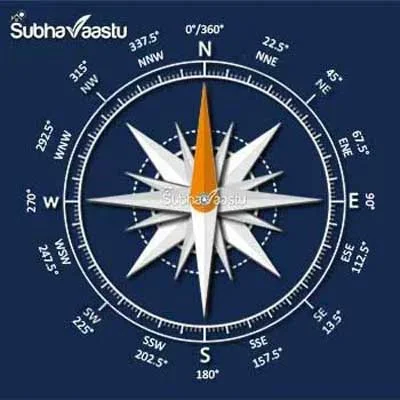 Directions play a crucial role in Vastu, an ancient Indian architectural science. Each direction is associated with specific energies and elements, impacting the flow of energy within a space. Proper alignment of rooms and objects according to directions in Vastu is believed to promote harmony, balance, and positive vibrations in the environment. For a plot, there are 4 principal directions, otherwise called cardinal directions and another four are auxiliary or intercardinal or ordinal directions.
What Are The Principal Directions?
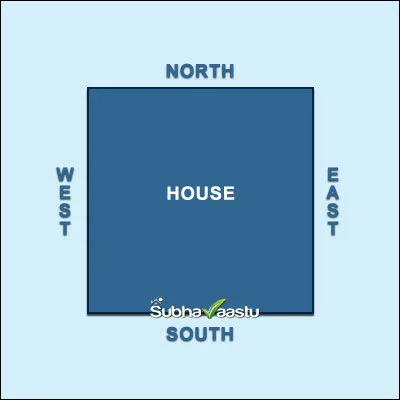 The four main directions, namely East, West, North, and South, are known as the principal (cardinal) directions. In the attached image, a model home is shown at the center, with all four directions clearly marked around it. This simple illustration helps explain how a house is positioned in relation to these principal directions.
What Are The Auxiliary Directions?
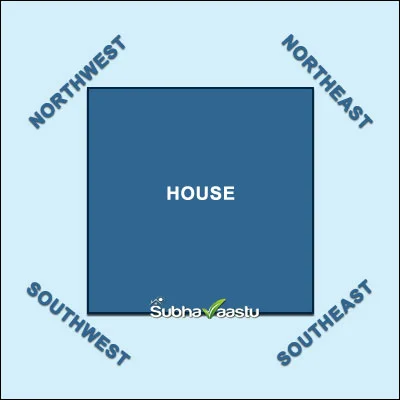 The auxiliary directions, also known as intercardinal directions, include Northeast, Southeast, Southwest, and Northwest. These directions lie between the four principal directions and help provide more accurate orientation for a home or plot. Each auxiliary direction can further be divided into finer sub-directions, allowing precise alignment. Understanding these directions makes it easier to evaluate placement, layout, and overall balance within a property.
House Direction Guide Showing Cardinal and Intercardinal Directions
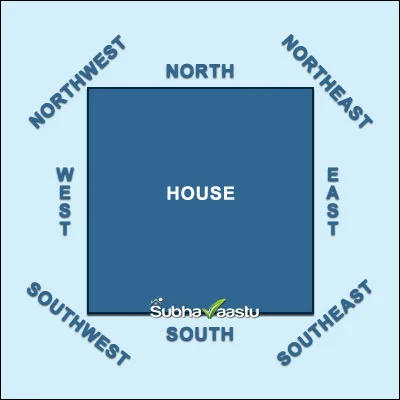 This combined diagram clearly illustrates both the cardinal directions (North, South, East, and West) and the intercardinal directions (Northeast, Northwest, Southeast, and Southwest) around a house. It serves as an easy reference for understanding how a property is oriented in relation to all eight primary directions. Such visual guidance helps residents better evaluate layout, alignment, and spatial balance, making it especially useful for planning, learning, and directional awareness.
Compass Directions and Their Corresponding Degrees
There are a total of 16 directions, comprising 8 cardinal directions and 8 intercardinal (ordinal) directions. Below are their names with corresponding degrees.
- 1. East Direction - Ninety degrees (90°)
- 2. East-Southeast Direction (ESE) - One hundred twelve point five degrees (112.5°)
- 3. Southeast Direction (SE) - One hundred thirty-five degrees (135°)
- 4. South-Southeast Direction (SSE) - One hundred fifty-seven point five degrees (157.5°)
- 5. South Direction - One hundred eighty degrees (180°)
- 6. South-Southwest Direction (SSW) - Two hundred two point five degrees (202.5°)
- 7. Southwest Direction (SW) - Two hundred twenty-five degrees (225°)
- 8. West-Southwest Direction (WSW) - Two hundred forty-seven point five degrees (247.5°)
- 9. West Direction - Two hundred seventy degrees (270°)
- 10. West-Northwest Direction (WNW) - Two hundred ninety-two point five degrees (292.5°)
- 11. Northwest Direction (NW) - Three hundred fifteen degrees (315°)
- 12. North-Northwest Direction (NNW) - Three hundred thirty-seven point five degrees (337.5°)
- 13. North Direction - Zero degrees (0°) or Three hundred sixty degrees (360°)
- 14. North-Northeast Direction (NNE) - Twenty-two point five degrees (22.5°)
- 15. Northeast Direction (NE) - Forty-five degrees (45°)
- 16. East-Northeast Direction (ENE) - Sixty-seven point five degrees (67.5°)
All Directions Information
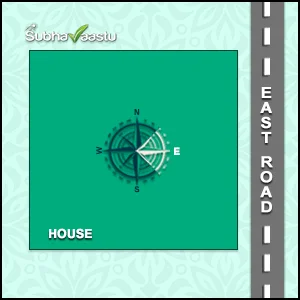
- Vastu for East Facing Homes
Explore the advantages and disadvantages of the East direction in this East link.
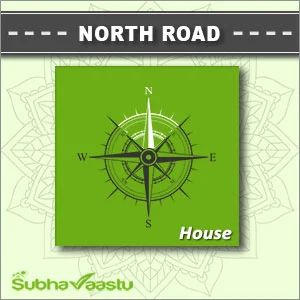
- Vastu for North Facing Homes
Discover the benefits and drawbacks of the North direction by visiting this North link.
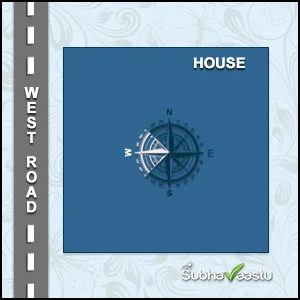
- Vastu for West Facing Homes
Know the merits and demerits of the West direction through this West link.
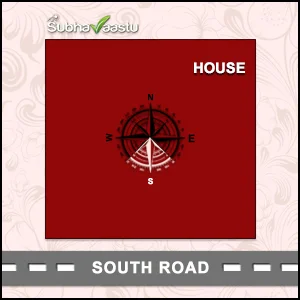
- Vastu for South Facing Homes
Understand the positive and negative effects of the South direction in this South link.
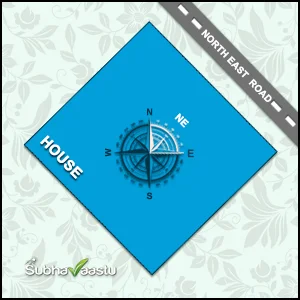
- Northeast Facing Vastu Homes
Learn about the strengths and weaknesses of the Northeast direction using this Northeast link.
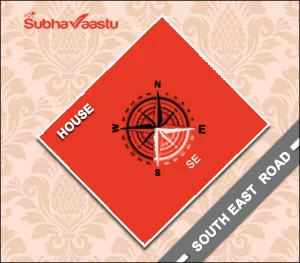
- Vastu For Southeast Homes
Find the pros and cons of the Southeast direction by clicking this Southeast link.
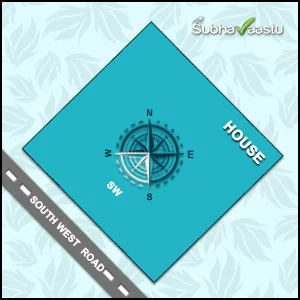
- Vastu benefits of Southwest Homes
Check the advantages and disadvantages of the Southwest direction in this Southwest link.
- North West Vastu Defects
Explore the positive and negative aspects of the Northwest direction via this Northwest link.
- Best Bedroom Vastu ideas
Learn Bedroom Vastu do's and don'ts via visiting this helpful Bedroom link.
What are the Secret Magical Numbers in All Directions?
Have you noticed a secret magic in direction degrees? When you add the digits of each direction's degrees, the sum is always "9". For example: East-Northeast = 67.5° (6 + 7 + 5 = 18; 1 + 8 = 9), and North-Northeast = 22.5° (2 + 2 + 5 = 9). This could be a reason why many people are fascinated with the number "9".
Many vehicle owners, including billionaires and millionaires, spend a significant amount to get registration numbers like "9", "99", "999" or "9999". It's a popular sentiment among them.
Significant Information on Directions
1. East-Southeast lies between East and Southeast, while South-Southeast lies between South and Southeast. These are sub-directions used for finer directional analysis.
2. South-Southwest and West-Southwest together form the broader Southwest zone.
3. West-Northwest and North-Northwest together form the Northwest zone.
4. For Vastu assessment, a plot or house is divided into eight directions starting from the central point known as Brahmasthan.
5. Brahmasthan represents the geometric center of a plot or building.
6. Ideally, plots should have regular shapes (square or rectangular). Irregular shapes may require corrective planning. Aligning the plot parallel to the adjoining road is generally preferred where possible.
7. Vastu measurements begin by identifying magnetic North using a compass.
8. Place the compass at the center of the plot or flat, mark North and South, and draw a straight reference line between them.
9. From the same center point, draw a perpendicular line to establish East and West. This completes the four main directions.
10. Each primary direction is then divided further to identify intercardinal zones (Northeast, Southeast, Southwest, Northwest), creating eight directional segments around Brahmasthan.
11. These divisions help determine the influence of the four cardinal and four intercardinal directions on the property.
12. The remaining corner areas form the Northeast, Southeast, Southwest, and Northwest zones. A central square or rectangular area aligned with the building outline is considered the Brahmasthan.
13. In flats or apartment complexes, in addition to the eight horizontal directions, two vertical zones, Sky (Up) and Earth (Down), are also considered in traditional Vastu practice.
14. Services such as overhead tanks, staircases, pumps, and utility areas are usually located on the ground or rooftop levels.
15. Since these shared services influence the entire building, Vastu practitioners often consider all ten directions (including Sky and Earth) for apartments.
16. Many assume each direction occupies exactly 45°. In practice, for residential planning, dividing directions equally into 45° segments generally provides workable results.
17. Scientifically, the Sun does not rise or shine at a fixed angle throughout the year due to Earth’s axial tilt. Therefore, compass-based measurement is preferred over solar observation.
18. Using approximate 45° divisions is sufficient for most homes. Minor variations do not usually create noticeable differences in practical Vastu applications.
19. It is important to understand the difference between true north and magnetic north.
20. Magnetic north differs slightly from true north because of Earth’s magnetic field generated by its molten iron core. Determining true north requires advanced calculations, while magnetic north can be easily identified with a compass.
21. For practical Vastu purposes, using magnetic north and standard directional divisions is widely accepted and sufficient in most residential and commercial situations.
What are the International Standards in Directions?
 1. The international standard dictates that North is always at the top. When reviewing a house plan, it is customary to mark the North direction at the top, with this orientation present in 99% of house plans. However, for convenience, some engineers might adjust the North point on their floor plans.
1a. For example, community layout maps in USA often do not show North at the top, as the North point is adjusted for practical reasons. When reviewing floor plans, first identify the North point. Only after locating north should you proceed with the rest of the floor plan details.
2. Vastu for Directions: Before delving into this topic, please acquaint yourself with "How to Find Directions". In Vastu, understanding directions is crucial, similar to the importance of eyes in a human body. Accurately determining the directions of a property, whether it is a house, land, or factory, is essential for assessing its positive or negative influences as described in Vaastu Shastra.
3. The four primary compass directions are known as the cardinal directions: North, South, East, and West, abbreviated as N, S, E, and W. It is suggested that the term NEWS derives from these directions.
4. These main compass points are also referred to as cardinal points, with each direction sometimes prefixed with “due”, such as "due north".
5. The directions situated between the cardinal points are called ordinal directions, which include Northeast (NE), Southeast (SE), Southwest (SW), and Northwest (NW), and are also known as intercardinal directions.
6. Located between each cardinal and ordinal direction are the secondary-intercardinal directions, which total eight. These include NNE (22.5°), ENE (67.5°), ESE (112.5°), SSE (157.5°), SSW (202.5°), WSW (247.5°), WNW (292.5°), and NNW (337.5°). To determine these directions, add 22.5° to each corresponding ordinal direction.
7. Similar to how a doctor depends on a stethoscope to assess a patient's health, a Vastu consultant requires precise directional knowledge to properly evaluate a property and provide accurate advice. Without such knowledge, even a famous Vastu consultant would struggle to make effective evaluations.
8. Misidentifying the directions of a property can lead to errors that persist through the development process, adversely affecting the occupants and their descendants. Although errors are common, vigilance is crucial in this field to prevent long-term issues among residents.
9. In Vastu Science, Magnetic North is used as a baseline to establish other directions. Depending on whether properties are regular or skewed, the primary directions, East, West, North, and South, are aligned perpendicularly in regular plots but may not align perfectly in skewed plots.
10. The central point of a property, known as the Brahmasthan, is essential. After plotting a property on a map and identifying the Brahmasthan, the principal directions are marked accordingly.
11. The Earth’s axial tilt at 23.5 degrees influences the positions of sunrise and sunset, which affects how true east and other directions are determined. The cardinal directions are integral parts of any property evaluation, each covering specific degrees in the compass layout, ensuring accuracy whether the property is regular or skewed.
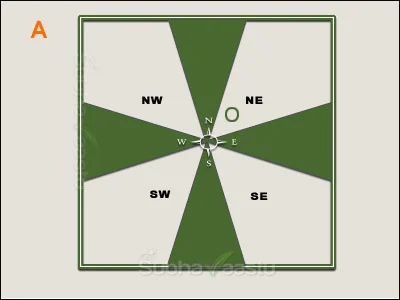 "Fig A" is a regular square plot. "O" is Brahmasthan which is the geometric center of the plot.
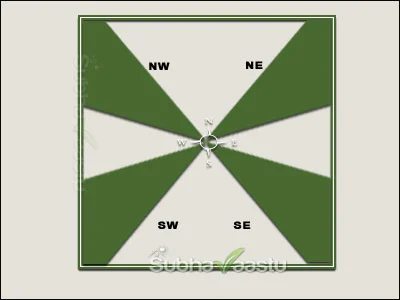 "Fig B" is a skewed plot, yet square. Note how NE, SE, SW, and NW are sited with reference to the regular plot.
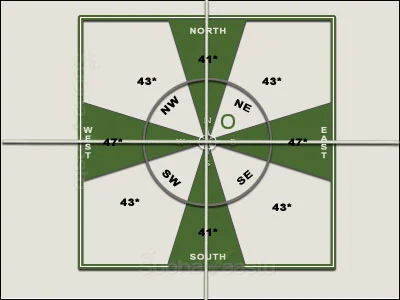 "Fig C" is a rectangular plot and regular with reference to the principal directions. Note the positions of NE, SE, SW, and NW.
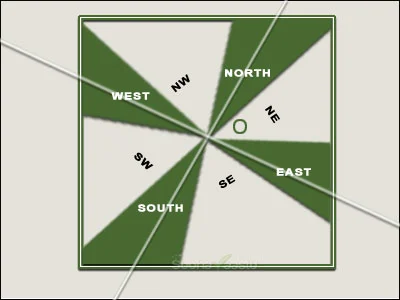 "Fig D" is a rectangular skewed plot. Again note the siting of NE, SE, SW, and NW.
Always mark the directions of the plot/house are a room with reference to the geometric center of the same. Needless to repeat that the geometric center is the Brahmasthan. In every direction, one half of the same is exhalted where one can locate doors so that movements reduced positive energies. Those on the other half or debilitating half where if there are doors produced adverse negative energy.
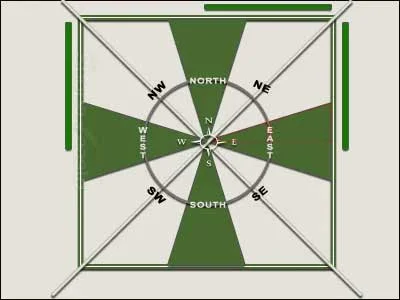 In "fig-2", the exalted half of each of the eight directions are indicated with green lines. At these precise positions, doors produce positive energy. Note that all of Northeast direction is exalted. Similarly, all of Southwest directions is debilitating.
A. “Directions in Vastu” form a fundamental part of Vaastu consultation. Traditionally, directions were identified by observing the Sun in the early morning, facing the rising Sun indicates East, with West behind you, North to your left, and South to your right. While this method offers a basic understanding, it is not always accurate.
B. In many situations, the Sun may not be visible due to clouds or weather conditions. In such cases, a compass becomes essential. A compass reliably indicates North using Earth’s magnetic field and works during day or night, in any season, making it a dependable tool for directional identification.
C. A standard compass displays directions using degrees: 0° or 360° for North, 90° for East, 180° for South, and 270° for West. Although some Vastu Pandits still estimate directions manually by observing sunrise, this method lacks precision because the Sun does not rise at the exact same point throughout the year.
D. In earlier times, experts depended on sunrise observation because compasses were not commonly available. Today, however, accurate tools are easily accessible. For reliable Vastu assessment, consultants should always use a compass, as proper directional measurement is the foundation of any meaningful site evaluation.
Imaginary Animated Directions File
 1. This animated compass image is provided for reference purposes only. The arrow initially points to “0°,” which represents North. In compass readings, both “0°” and “360°” indicate North. Similarly, 90° represents East, 180° represents South, and 270° represents West.
2. You may observe that the arrow rotates from North (0°) and completes a full circle to return to North (360°). This visual demonstration helps explain how directions correspond with degree measurements.
3. In standard compass orientation, North is always shown at the top. Most images on this site follow this international convention. In a few cases, East has been placed at the top for layout or illustration purposes; however, those images clearly display a compass or road direction so viewers can easily identify the remaining directions.
4. If you find any image without a directional compass or clear directional guidance, please inform us through the SubhaVaastu Contact Details page so we can correct it promptly.
5. The arrow sequence follows this order: 0° (North), 90° (East), 180° (South), 270° (West), and finally returns to North (360°), completing a full directional cycle.
6. Directional arrows are shown using different colors to help visually distinguish each direction. If this section feels unclear, the information provided below may help improve understanding.
Best Example Of Finding Directions Through Animated Image
 Please wait for just **5 SECONDS** and observe carefully. You will see a dark landscape with faint sunlight starting to appear. As the Sun begins to rise, light gradually fills the area, leading to a visible sunrise (dawn). A man then appears facing the Sun, with his back towards us. He raises his hands, and shortly after, the word "East" flashes on the screen, indicating the direction. The man's back is towards the "West," which is also displayed. "North" appears on the left-hand side, and "South" on the right-hand side. We hope this visual helps clarify the concept.
Directions With Degrees
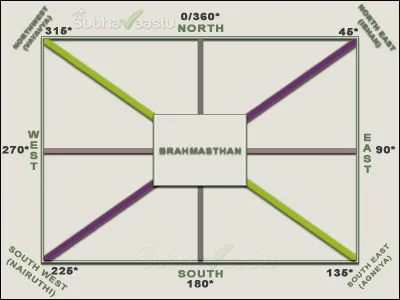 Each direction holds its own unique significance. Different planets are associated with various directions, and each planet has a specific color that brings auspicious effects. For instance, North is associated with Green and ruled by Kubera, East with White/Orange and ruled by Indra, South with Red and ruled by Yama, and West with Blue, governed by Varuna, the Rain God.
2. See this picture to learn about auxiliary directions. This will help you better understand information related to degrees. Vaasthu Couplet: Vastu offers not only wealth on earth but also bliss in the celestial world. Respect all the lords and all directions, and residents will be blessed.
3. We are also planning to publish detailed information on the Brahmasthan, the central, powerful portion of a structure. The merits and demerits of Brahmasthan will be discussed on other pages. This image is clickable and will direct you to the compass link.
4. The meeting point of two directions is commonly referred to as the "Junction," "Corner," "Intersection," "Joint," "Confluence," "Assembly Point," or "Gathering Point." While some residents may use different terms, most people simply refer to it as 'Corner,' which is the most commonly used term.
Which Is More Reliable For Finding Directions : Sunrise Or A Directional Compass?
1. A directional compass is the most accurate and dependable tool for identifying directions of land, houses, flats, or any location. Although many people traditionally rely on sunrise or sunset, this method is not precise.
2. The Earth is tilted on its axis, which causes the Sun to rise at different points along the horizon throughout the year. Except during the equinox periods, the Sun does not rise exactly in the East or set exactly in the West. Therefore, using sunrise or sunset can result in directional inaccuracies.
3. A compass, on the other hand, functions based on Earth’s magnetic field and consistently indicates the North-South reference. This makes it scientifically reliable regardless of season or date.
4. For accurate site evaluation, architectural planning, or Vastu assessment, it is always recommended to use a directional compass instead of estimating directions from the Sun.
The Importance of Corners in Directions
1. A corner is the meeting point of two directions. Because of this, every corner carries the combined influence of both directions. These mixed directional energies make corners especially significant in building design.
2. Therefore, corners should be carefully planned during construction. Special attention is required for the Northeast corner, as it is traditionally considered delicate and highly influential for growth and development.
3. The Northeast is regarded as a salient feature of any property. Although every house has the same eight directions, their effects vary based on usage, construction quality, neighborhood influence, and overall maintenance. When followed according to the principles of Vasthu, a house is believed to support the well-being of its residents.
4. When construction goes against these principles, the living environment may feel uncomfortable or stressful. Directional impact largely depends on how occupants utilize and manage the space.
5. For example, if the Northeast (Ishan) corner is properly designed, residents may experience better satisfaction, gradual progress, prosperity, and stability in life.
6. If the Northeast corner is disturbed, truncated, or blocked, occupants may experience setbacks such as reduced growth opportunities or challenges in family harmony and education. Understanding Vastu concepts helps people avoid unnecessary stress.
7. By learning specific Vastu principles, people can choose positive spaces that promote harmony, health, and financial stability. Vastu is a vast subject, and thoughtful application can support a balanced living environment.
8. Proper building orientation contributes not only to energy efficiency but also to better architectural design, comfortable living, and improved quality of life for occupants.
9. Orientation also considers the relationship between planetary movement and building directions with respect to the North. Using suitable local materials and correct orientation can enhance a building’s durability and improve occupants’ comfort.
10. There are examples where buildings lacking proper orientation deteriorated faster than those constructed with careful directional planning. Proper orientation requires clear understanding of all Eight Directions.
11. It is commonly known that the Sun rises in the East and sets in the West. When facing East, North lies to the left and South to the right.
12. Corners, where two directions meet, are more influential because they combine the effects of both directions. The eight primary directions are North, Northeast, East, Southeast, South, Southwest, West, and Northwest. Traditional Vastu principles are based on these.
13. Are there eight directions or ten directions? Some practitioners recognize ten directions by including Sky (Up) and Earth (Down). This is considered a philosophical extension of Vastu, and future research may further explore these concepts.
Northeast Direction Shown With Animated Picture
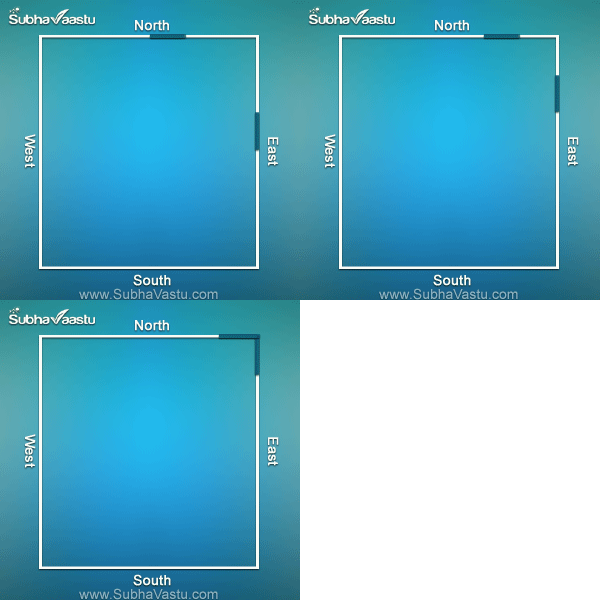 1. This image shows a white boundary line with all directions clearly marked. North is positioned at the top and East on the right-hand side. The animation highlights two small blue patches merging into one corner, representing the Northeast (NE). Since Northeast lies between North and East, it is named accordingly.
2. In traditional Vastu practice, the Northeast corner is considered significant. It is commonly referred to as “Daiva Moola” or the divine corner. Conceptually, this area is associated with openness, light, and positive energy flow.
3. Care should be taken to ensure that the Northeast corner is not disturbed by truncation, severe cutting, or improper structural modification. Minor rounding may not always cause impact, depending on site conditions and overall layout.
4. When the Northeast corner is open, well-maintained, and free from major obstructions, residents may experience better peace of mind and gradual personal or professional progress. In Vastu belief systems, this corner is also associated with learning and growth.
5. Traditionally, this direction is linked with Lord Eshwar (Shiva) and is sometimes referred to as “Eshanya.” During Bhoomi Pooja (ground-breaking ceremonies), rituals are often performed in this corner as part of customary practice.
6. Pouring holy water and maintaining cleanliness in this area are symbolic practices meant to promote positivity. In Vastu, placing water elements in the Northeast is generally considered favorable.
7. Keeping this corner open and accessible is believed to support mental calmness and clarity. For further details, please visit Northeast Facing House Vastu.
Southeast Direction Displayed With Animated Image
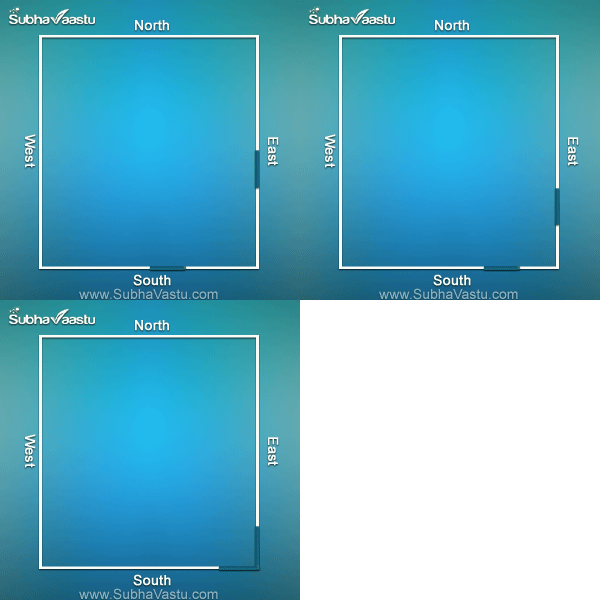 1. This animated image shows a blue patch formed by combining the East and South directions, representing the Southeast (SE) corner. Since corners are created by the meeting of two directions, they carry the combined influence of both. For this reason, extra care is advised while planning corners or irregular layouts such as Skewed Plots.
2. In traditional Vastu practice, the Southeast is associated with the fire element and is commonly recommended for placing the kitchen. Secondary suitable placements may include staircases or toilets, depending on the overall layout. Among these, the kitchen is usually given first preference.
3. When this area is improperly planned or disturbed, residents may experience challenges such as stress, poor decision making, financial instability, relationship conflicts, health concerns, or lack of focus. These effects are described within Vastu belief systems and depend greatly on the overall structure and usage of the space.
4. When the Southeast corner is properly designed and used, occupants may experience improved health, smoother daily routines, better hospitality, and a more balanced domestic environment.
5. For more detailed guidance, please refer to this Southeast Facing House Vastu page.
Southwest Direction Displayed With Animated Image
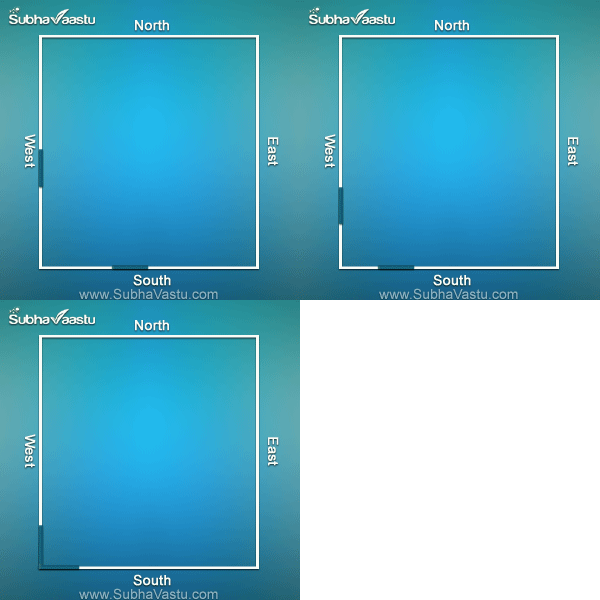 1. This animated image highlights the Southwest (SW) corner. Traditionally, this direction is known as Nairuthi (also spelled Nirruthi or Rakshasa Moola). It lies between the South and West directions. The portion closer to West is sometimes called West Nairuthi (Paschima Nairuthi), and the portion closer to South is referred to as South Nairuthi (Dakshina Nairuthi).
2. In Vastu tradition, the Southwest is considered a powerful zone associated with stability, strength, and control. Elders often emphasize that while a well-balanced Northeast supports growth, an improperly planned Southwest may create imbalance in a property.
3. When the Southwest corner is weak, disturbed, or improperly used, residents may experience challenges such as health concerns, unexpected expenses, stress, or instability. These observations belong to Vastu belief systems and depend greatly on overall planning and lifestyle factors.
4. When the Southwest corner is strong, well-constructed, and properly utilized, it is believed to provide structural stability, leadership qualities, and long-term security to occupants.
5. Traditionally, Nairuthi is associated with qualities such as firmness, dominance, and determination. Therefore, this area should be handled carefully in design to avoid excessive heaviness or imbalance.
6. Vastu practitioners often examine the Southwest corner when investigating financial instability or recurring health issues, as this zone plays a major role in grounding and sustaining a building.
7. For more detailed guidance, please refer to this Southwest Facing House Vastu page.
Northwest Direction Displayed With Animated Image
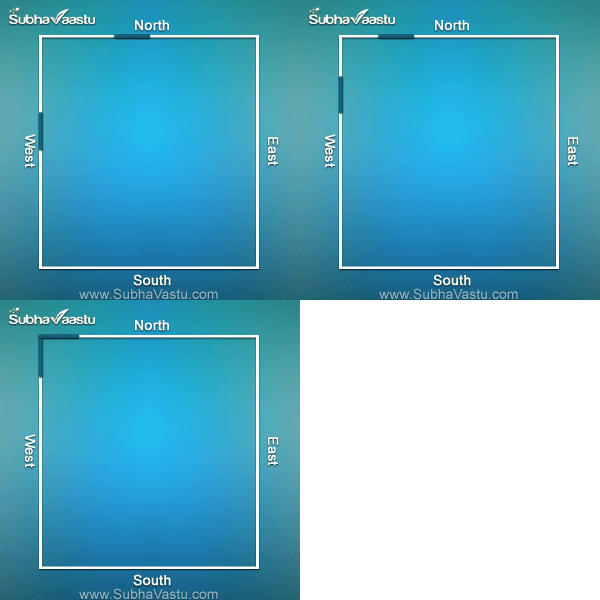 1. This animation highlights the Northwest (NW) corner, formed by the junction of North and West directions. This corner is traditionally known as Vayavya Kon. Since it combines the influence of both North and West, it is considered a dynamic zone in Vastu planning.
2. In Vastu belief systems, the Northwest is associated with movement, communication, relationships, and financial flow. Proper utilization of this area is believed to support mental balance, social connections, and stability in daily life.
3. When the Northwest is poorly planned or disturbed, residents may experience challenges such as emotional instability, misunderstandings, financial fluctuations, or stress. These interpretations belong to traditional Vastu concepts and depend greatly on overall building design and lifestyle factors.
4. Traditionally, this direction is also linked with the air element (Vayu). When balanced, it is believed to support clarity of thought, emotional strength, learning abilities, and harmonious family relationships.
5. The Northwest is often associated with women of the household, children, and emotional well-being. Maintaining cleanliness, openness, and proper functional use in this area is considered beneficial in Vastu practice.
6. For more detailed guidance, please refer to this Northwest Facing House Vastu page.
Sun's Journey From Uttarayan to Dakshinayan and to Next Uttarayan
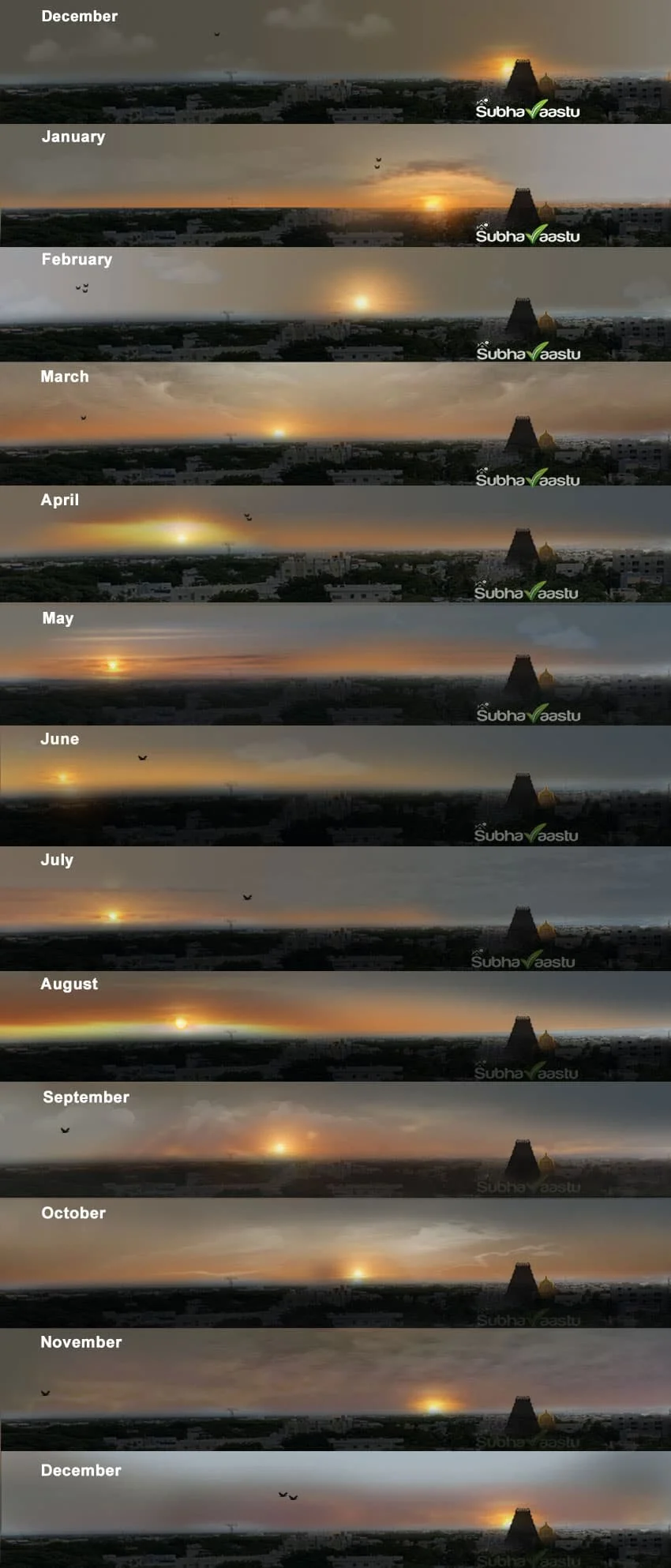 1. The sunrise in the East is photographed every month on the same day and at approximately the same time from the same location. These photographs are used to document the sun's lateral movement along the eastern horizon throughout the year.
2. Showing that Earth is wobbling while journeying around the Sun, this wobbling is to the extent of 47° from the meridian 23 1/2° of each side. In the wobbling of the earth on 21 March of every year, the sun is directly facing the equator on 21st march when the earth starts wobbling down so that the Northern hemisphere faces fully towards the Sun.
3. The ancient Rishis recognized this aspect and looked for the date as an auspicious moment to start any huge construction activity.
4. The Konark temple in Odisha is constructed taking these aspects into the view and very properly placed vis-a-vis Sun.
5. There are many temples in South India where Sunrays falls on the principal diety on a particular date and time only. One can see this phenomenon in Hampi Virupaksha Mandhir and Shiva Mandir in Tadipatri, Anantapur District, and Suryanarayana Swamy temple in Srikakulam, and many other places.
6. It is indeed a great tribute to the ancient seers as to how they visualized these phenomena without modern-day techonology etc.
Sunrise Direction Changes After March 21 (Equinox)
1. On or around the March equinox, the Sun rises almost exactly in the East at 90° azimuth. This is a special time of the year when day and night are nearly equal across the world.
2. After March 21, the Sun does not remain fixed at 90°. Instead, it begins a gradual shift towards the North-East direction. Each day, the sunrise point moves slightly by about 0.3° to 0.4°, which is a very small change but becomes noticeable over time.
3. For example, on March 22 the Sun rises around 89.7°, on March 23 around 89.4°, and continues shifting further northward in the following days. Within a month, this results in a total shift of nearly 9° to 10°.
4. In simple terms, after the equinox, the Sun rises north of East, and this movement continues until the June solstice. Understanding this natural shift is important in Vastu and directional studies, as it influences sunlight entry and energy flow in a property.
Simple SummaryDaily shift ≈ 0.3° (very small but noticeable over time)
In 10 days → about 3° shift
In 1 month → about 9–10° shift
Solstice (Ayanantham) - Simple Notes
1. Solstice (Ayanantham) is the time when the Sun reaches its maximum position either towards the North or South.
2. It occurs twice a year - once in June and once in December.
3. The June Solstice (around June 21) is the day with the longest daylight of the year.
4. The December Solstice (around December 21 or 22) is the day with the longest night of the year.
5. During solstice, the Sun appears at its highest or lowest point in the sky at noon.
6. After the June solstice, the Sun gradually starts moving southward, and after the December solstice, it starts moving northward.
7. Solstice plays an important role in seasonal changes and affects climate patterns.
8. Understanding solstice is useful in Vastu and directional planning, as it influences sunlight direction and energy flow.
The Placement of Quadrants According to Directions
1. To help you understand this concept clearly, several images are displayed below. Please observe all of them carefully. Viewing only one image may not provide a complete understanding. Here, we are considering a single place or house, and the visuals explain how that location is divided into different directional parts and how each part is identified.
2. These illustrations are intended to guide readers through a visual explanation of spatial layout. Such representations are commonly used in architecture, planning, and directional studies to help people recognize how a single property can be segmented into multiple zones based on compass directions.
3. The term “Quadrants” refers to zones or divisions within the same location. These may also be called portions, sections, partitions, or parts. Although all images relate to one property, different terms may be used to describe these areas depending on context or interpretation.
4. Understanding these quadrants helps in identifying how each directional segment contributes to the overall layout of a site, which is useful for planning, design, and traditional directional assessments.
East and West Quadrants
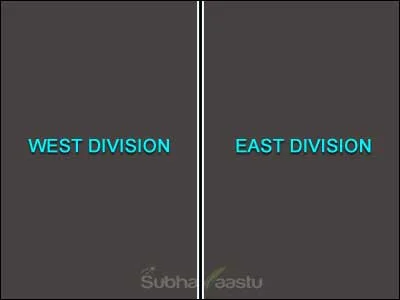 When this location is divided into two parts, it is described as the East and West parts. The division line, known as the dividing line, extends from the north to the south. When the location is split into two equal parts, there is an opportunity to refer to them as the East and West parts. This image elaborates on how a specific location is geographically divided, emphasizing the equal partition into East and West segments by a line running from north to south. This kind of division is typical in spatial planning and Vastu descriptions, often used to simplify navigation and management of areas.
North and South Quadrants
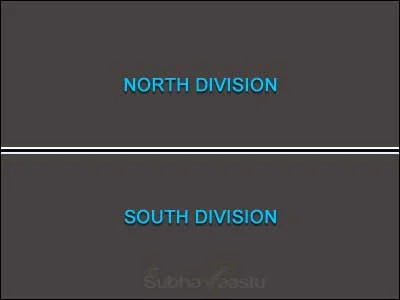 Please observe this image. Here, the same location shown above is divided in another manner. It has been divided into North and South quadrants, meaning this location can be described as divided into two portions. You can refer to them as the North part and the South part of the location. This image describes a scenario where a specific location is viewed and divided differently in an image, with a focus on the north-south division, illustrating an alternative perspective or method of partitioning the same geographical area.
Travel Over the Four Directional Quadrants
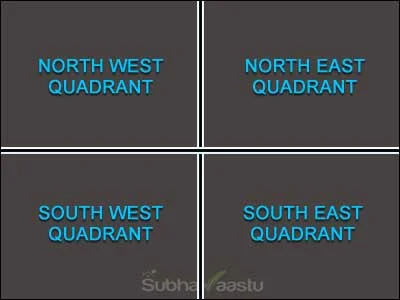 Please observe this image. This place has been divided into four parts: the northeast, southeast, southwest, and northwest sections. Please note that all these divisions pertain to the same location. This image explains how a place is segmented into four directional quadrants, which is useful for detailed Vastu orientation or spatial planning, indicating a comprehensive division that covers all main directions.
NorthEast and SouthWest Divisions
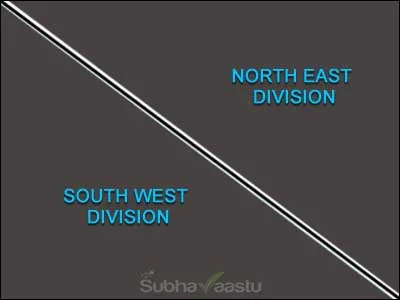 In this image, the place is divided into the Northeast and Southwest parts. You may notice that even though it is the same place, it is referred to in different ways. This place highlights how a single geographic location can be segmented and labeled in various ways, emphasizing the flexibility and diversity of spatial terminology based on directional divisions.
NorthWest and SouthEast Divisions
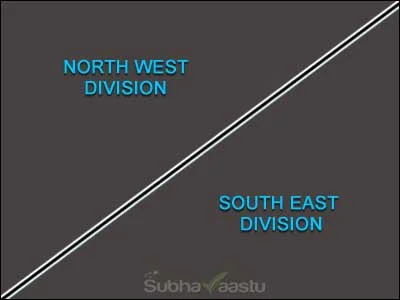 This place has also been divided into two parts. The Northwest and Southeast sections. Although it is the same place, carefully consider how many names it has. This place conveys the idea that the same geographical area can be identified by multiple names depending on how it is divided or referenced, highlighting the complexity and variability in naming parts of a single place.
Exploring the Six Enchanting Regions
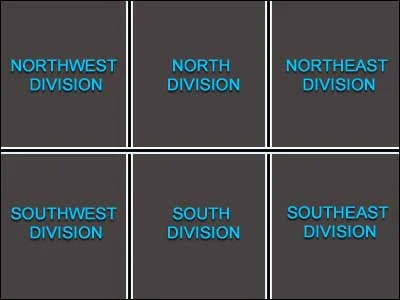 In this image, the place has been divided into six parts. The Northeast, Southeast, South, Southwest, Northwest, and North sections. This place describes how the image illustrates the division of a specific area into multiple directional sectors, encompassing all primary and some secondary cardinal directions. This detailed segmentation could be useful in various contexts such as Vastu findings, geographic education.
Discover the Six Captivating Divisions of This Place
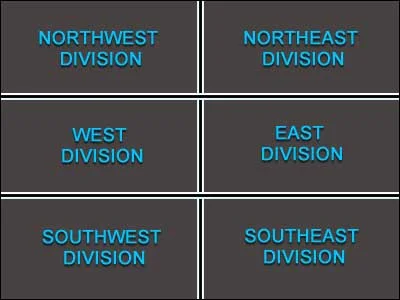 Please observe this image, the place has also been divided into six parts, but the names are changing, so pay careful attention. The divisions are the Northeast, East, Southeast, Southwest, West, and Northwest sections. This place highlights the segmentation of a specific area into various parts using both cardinal and intercardinal directions. It also notes that the names of these divisions may change, suggesting a need for careful observation to understand how the area is described in different contexts or documents.
Explore 9 Enthralling Sections of a Place
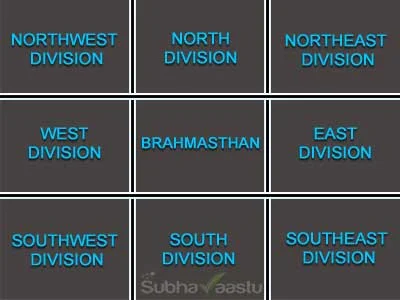 If you observe this diagram lastly, the place has been divided into nine parts. The Northeast, East, Southeast, South, Southwest, West, Northwest, North, and the central area is referred to as the midpoint or 'Brahmasthana'. Now, the same place is divided into nine divisions. This place details how a specific location is intricately divided into eight directional zones surrounding a central mid point, which is termed 'Brahmasthan', a concept often found in traditional Indian Vastu and spatial planning, denoting the central, most sacred part of a structure or space.
1. Observe how one location is called by many different names. For example, a person is referred to as a son, husband, brother, father, brother-in-law, son-in-law, officer, manager, chairman, or a friend, but it's still the same person. Similarly, the place is the same, but how various names are applied to it should be carefully observed.
2. This place highlights the idea that just as a person can have multiple roles or identifiers depending on the context or relationship, a single geographic location can also be referred to by various terms, each reflecting a different aspect or "CHARACTERISTIC OF THE PLACE". This analogy helps illustrate the complexity of naming and categorization, whether it pertains to human roles or spatial divisions.
3. A skilled Vastu consultant meticulously examines every corner of a location from various angles to uncover the facts about the place or home. They have a deep understanding of how to identify the unique characteristics of a home. Wise residents (For example NRI's) always seek opinions from these experts and always avoiding those with only partial knowledge, regardless of their service fees.
Is There Any Particular Direction to Move When Buying a New Home?
Dear Sir, kindly let us know if there is any specific Vastu guideline about choosing the direction of a new home when relocating, for example, whether the new residence should be located to the North, South, East, or West of the current home. - Balaji - Chennai
Respected Balaji, One practical case often shared involves a resident named Madhusudhan, who received astrological advice in 1993 to move only toward the Northeast from his existing home. He followed this guidance and purchased a house in that direction. However, after moving, he experienced several personal difficulties.
Later, when he considered relocating again, the same astrologer insisted he should move only toward the Northeast once more. Since no suitable property was available in that direction, Madhusudhan eventually chose a home located to the Northwest of his original residence and shifted there in 1996.
Contrary to earlier predictions, he lived peacefully in that home for many years. Over time, his financial condition improved, and he was able to invest in additional properties. This experience highlighted that blindly following directional movement advice alone does not determine life outcomes.
This example suggests that selecting a new home should be based on practical factors such as Vastu of the home, the quality of the property, internal layout, surroundings, and personal comfort, rather than merely the direction of relocation from a previous residence. In Vastu practice, the internal & external orientation of a house is generally considered more important than its relative position to a former home.
Finally, you don’t need to worry about the direction when moving to a new home. If the new house is well planned according to Vastu, you can move there with confidence without thinking about its position compared to your current home. One important thing to remember is the distance between your old home and the new one, because the effect of relocation depends more on the overall location and surroundings than on direction alone.
Frequently Asked Questions On Vastu Directions
Here are some commonly asked questions about Vastu directions, designed to help residents understand house orientation, room placement, and practical guidance for choosing or planning a home.
What Are The Main Directions Used In Vastu For A House?
The main directions in Vastu include North, South, East, West, along with Northeast, Southeast, Southwest, and Northwest. These eight directions help determine room placement, energy flow, and overall balance of a house.
How Can I Find The Exact Directions Of My Home?
The most reliable way to find directions is by using a directional compass. Sunrise or sunset should not be used because the Sun shifts its rising position throughout the year. A compass gives consistent North, East, South, and West readings on any day.
Why Are Directions Important In Vastu Shastra?
Each direction is believed to influence different aspects of life such as health, stability, prosperity, and peace. Proper use of directions helps create harmony inside the home and supports comfortable living.
Is Sunrise A Correct Method To Identify East Direction?
No. The Sun does not rise exactly in the East every day due to Earth’s tilt. For accurate directional identification, a magnetic compass is always recommended.
Which Direction Is Best For Kitchen, Bedroom, And Main Entrance?
Traditionally, the kitchen is preferred in Southeast, the master bedroom in Southwest, and the main entrance in North or East. These placements are based on Vastu principles and practical energy flow.
Do I Need To Move Only In A Specific Direction When Buying A New Home?
No. There is no strict rule that a new home must be located in a particular direction from your current residence. What matters more is the internal Vastu of the new house, its surroundings, and overall livability.
Is Perfect Vastu Alignment Mandatory For Every House?
Perfect alignment is ideal but not mandatory. Even partial Vastu compliance, such as correct kitchen or bedroom placement, can improve comfort and balance when full alignment is not possible.
June Solstice (Longest Day of the Year) – Understanding the Sun’s Northernmost Position
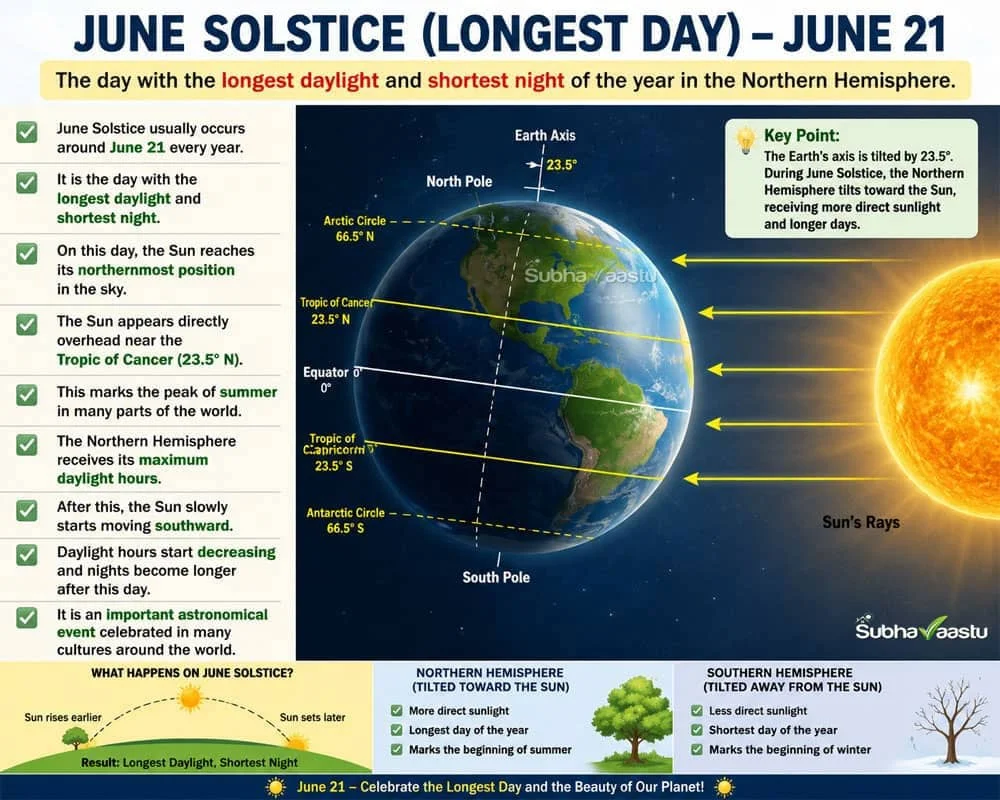 The June Solstice, usually occurring on June 21, is the longest day and shortest night of the year in the Northern Hemisphere. On this day, the Earth's Northern Hemisphere tilts most directly toward the Sun, resulting in maximum daylight hours. The Sun reaches its northernmost position in the sky and appears directly overhead near the Tropic of Cancer. After the June Solstice, daylight hours gradually begin to decrease as the Sun slowly shifts southward. This important astronomical event marks the beginning of summer in many countries and demonstrates how Earth's axial tilt influences the changing seasons throughout the year.
Have Any Questions?
 Respected residents may send their questions on this article. Expect a reply within 5 minutes to 24 hours, depending on proper greeting.
Answers For All Vastu Doubts
- Is windows at Southwest is good?
- Who is the best vastu consultant in Delhi?
- 45 frontyard vastu tips checklist information
- Constructing water sump at Brahmastan is bad?
- How to find best vastu consultant in Los Angeles?
- Can we construct septic tank at West, is this wrong?
- Is east-Southeast street focus home is good or bad?
- Which is the best place to arrange guest room in my house?
Vastu Testimonials Delivered By Respected Residents
Dear Suresh, I am pleased to inform you that like the way you provided consultation for my home and explained to me all the changes required inside and outside home. I really appreciate the diagrams that you prepared for my home with pictures and arrows showing the changes need to be done. Above all, you explained very well the reasons behind changes you recommended for my home with great clarity and sense of humor. No doubt in my mind, you are the best Vastu expert, I really appreciate your dedication by building and maintaining a very informative website that is helping thousands of people across the globe. Also, I sensed when I talk to you and when I was dealing with you, you follow honesty and integrity and you have a sincere desire to help others - Kotesware Rao - Dallas - USA
We are tech professionals and working in USA. After a year long search we brought the house. After buying the house I started looking for consultant who can help me evaluating the house. I came across Subhavaastu website which has lot of information. I contacted Mr.Suresh and requested him to help with our house vastu. It has been an incredible delight working with him.. He is very detailed oriented person and never compromises with his work. I am typically not interested to deliver the reviews. But after working with Mr. Suresh I decided to share my experience. Mr. Suresh has great expertise in providing vastu consultation to USA property. He is always available through email and phone l to answer questions. I am writing this review hoping it will help other people like me who lives in abroad. Please take advise before buying the house. I highly recommend Mr. Suresh as he has great experience with structure of USA properties and also he provides genuine consultation. I really appreciate Mr. Suresh's help in evaluating our house - Padma - Boston - USA
"I contacted Sureshji to consult on our current home. He was spot on in identifying vastu dosha in regards to the problems we were having. He suggested remedies but we are still looking for a new house. Since then I have been in touch with him for finding a right home for us. He is very sincere and truly wishes better lives for everyone. He doesn’t compromise with quality and is always responsive to queries. He recommends solutions as per location as Vastu rules differ for each country. He is greatly contributing to the society with his knowledge of Vastu and dedication towards his work. Keep up the good work Sureshji and wish you success and happiness!" - Megha - Virginia - USA
I have consulted Suresh Garu during December 2014 during the process of buying a house in Texas, USA. I have occupied the house for one year now, and feel like dropping a review regarding my experience during the entire process. I am very much satisfied with the kind of service I received from him. He is very knowledgeable and I was often stunned by his detailed analysis during the course of my interaction with him. He was very much accessible over phone (perhaps more than 10 times for one house plan!) and the price is very much reasonable especially compared with the cost of the house. I noticed his burning desire to help me in making informed decisions on certain things. I have seen some people pretending to know this subject and misguiding those who come for help by saying only what we want to hear. SubhaVaastu is definitely not that one. Finally, I am strong believer of leaving certain things to experts in those subjects. I have been in US for more than 13 years and have seen people doing their own corrections (by reading website articles) trying to save few dollars. Please don’t do that. You would end up in causing more damage. I highly recommend you to engage SubhaVaastu in your next project - Satish - Dallas - TX - USA
Announcement
Corruption Cases
Detailed Research on Corruption Cases An investigative study examining various factors and observations related to bribery cases.
Delayed Marriages
Exploring Vastu Factors Behind Delayed Marriages. An investigative study focusing on "The Impact of Vastu on Delayed Marriages" and exploring "Vastu Factors Contributing to Infertility Issues".
Vastu Questions
A comprehensive range of Vastu queries have been addressed here.100 Vastu Questions & Answers
Free Vastu Services
Who are eligible for Free Vastu Services, check this page.
30,000 Spiritual Wallpapers

Inspirational Quotations
"Take risks in your life. If you win, you can lead; if you lose, you can guide." - Swamy Vivekananda
“Great Personalities speak about thoughts. 'Average Person' talk about occasions. 'Narrow Minded' gossip about others.” ― Eleanor Roosevelt . . . Ask yourself honestly: Who are you? A GREAT PERSONALITY, an AVERAGE PERSON, or a NARROW-MINDED INDIVIDUAL?
Joke Of the Day
Murthy: When I first came to Rajahmundry, I started out selling peas on the banks of the Godavari. With the money I earned, I managed to open a small restaurant on the main road.
Shyam: "Oh, really? That’s great… and then what happened?"
Murthy: With the profits from that restaurant, I went on to open a big hotel.
Shyam: "Amazing… Jai Shri Ram! And then?"
Murthy: "During that time, I became friends with a film producer…"
Shyam: "Wonderful… and then?"
Murthy: "Later, I even produced movies together with that producer."
Shyam: "Incredible! You truly had great fortune… and then?"
Murthy: Now, I am back again… selling peas on the banks of the Godavari.
Vastu Tip of the Day
Follow us on Social Media




Follow us on WhatsApp

We introduced WhatsApp Channel from 16th November 2025. Here is the link - SubhaVastu Whatsapp Channel

ప్రత్యేకంగా మీ కోసం 200 అద్భుతమైన తెలుగు జోక్స్, నవ్వకూడదని అనుకున్నా కూడా నవ్వకుండా ఉండలేరు. చదవండి, ఆనందించండి, మీ ఆత్మీయ మిత్రులతో మాత్రమే పంచుకోండి. తెలుగు జోక్స్
Comments
1. How to handle the direction in such a case when it is not perfectly as per compass?
2. Do I need to move the main entrance door?
3. DO I need to move my seating place? Please advise.